The Dual Mental Model Theory of Consciousness
Source: Joe LeDoux, The Four Realms of Existence: A New Theory of Being Human (Harvard/Belknap, 2023).
Notes: https://jch.com/jch/notes/LeDoux4Realms.html
The name
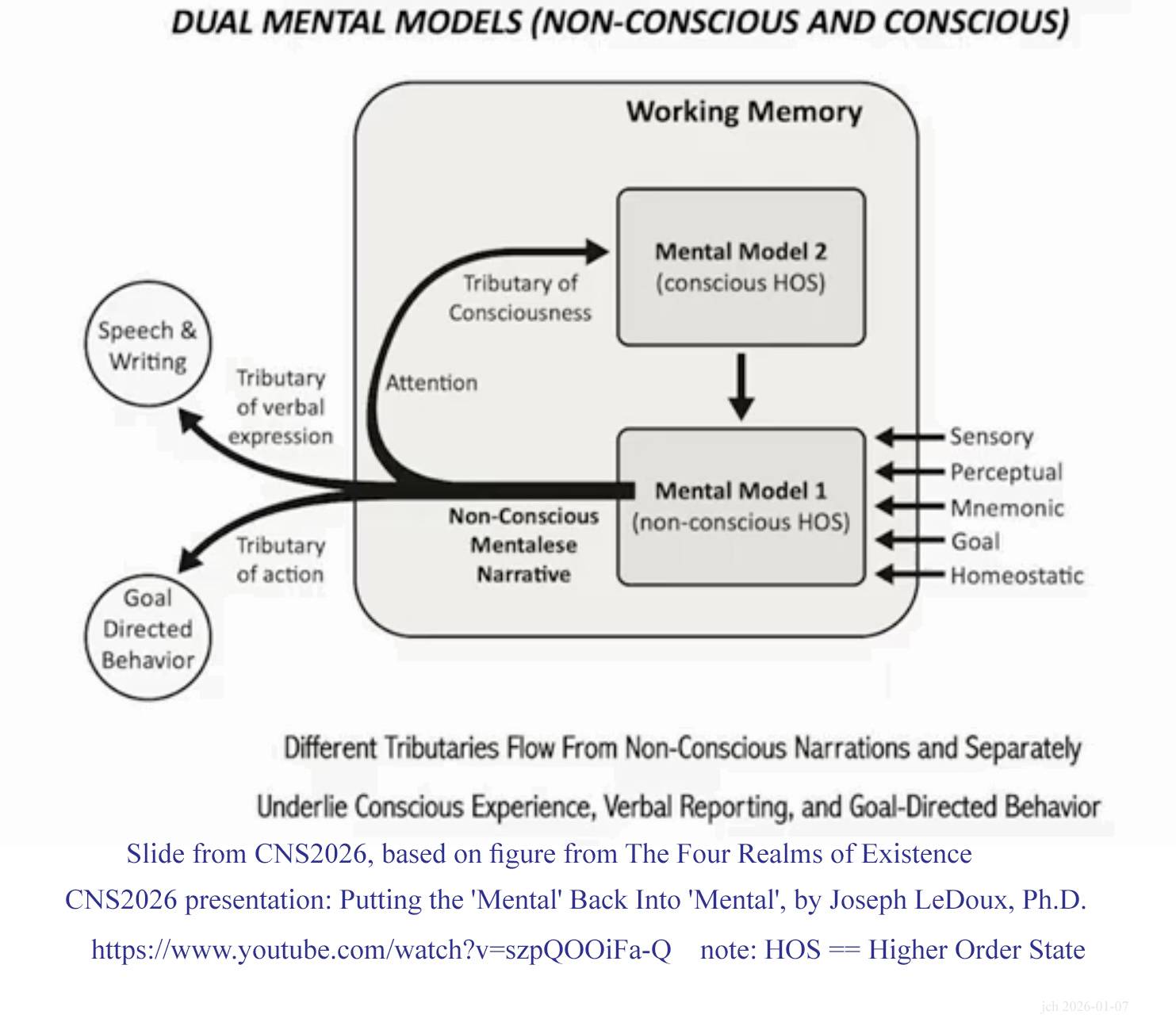
LeDoux calls his theory the "multi-state hierarchical higher-order theory of consciousness." That is a good short description, but not a name. "Dual Mental Model" (the short form used here) names its central idea: the brain runs two mental models, a pre-conscious one and a conscious one (LeDoux's Figure 26.2).
The four realms
The Dual Mental Model puts consciousness at the top of a nested, evolutionary hierarchy of ways an organism can exist. Each realm builds on the ones below it, and humans live in all four at once. LeDoux matches the top three realms to Endel Tulving's three levels of consciousness.
| Realm | Who has it | What it involves | Level of consciousness |
|---|---|---|---|
| 1. Biological | All living things, down to bacteria | Staying alive: metabolism, homeostasis, moving toward nutrients and away from harm | Creature consciousness (awake and responsive) |
| 2. Neurobiological | Animals with nervous systems | Reflexes, instincts, Pavlovian conditioning and habits, run by survival circuits | Anoetic (non-knowing; model-free) |
| 3. Cognitive | Some animals, especially mammals and birds | Building models of the world and using them to think, plan, decide and act, much of it without consciousness | Noetic (knowing; model-based) |
| 4. Conscious | Clearly humans; possibly some other species to a limited degree | Subjective experience, including modeling yourself in relation to time | Autonoetic (self-knowing) |
LeDoux defines cognition narrowly: "the capacity to construct models of the world and use these in thinking, planning, deciding, acting, and even feeling" (p.165).
The two mental models
Both models sit in working memory in the granular prefrontal cortex (PFC). The steps, as LeDoux lays them out (p.290–294):
- Binding. The brain assembles a multimodal picture of the present moment:
- Features within one sense are bound together first. For example, an apple's color and shape are bound in visual cortex.
- Next, areas in the parietal and temporal lobes combine the senses, and parietal and hippocampal circuits build episodic scenes.
- Schemas are assembled in the sub-granular PFC.
- Finally, everything is integrated into granular PFC working memory.
- The pre-conscious mental model (Model 1) holds this "higher-order state" of the present moment.
- It keeps recurrent loops with the lower-order input circuits, which update and sustain the model.
- Its content is an event chunk: a few hundred milliseconds of neural activity bundled together by postdictive processing.
- It is the go-to mechanism for controlling behavior in routine situations.
- The mentalese narrative. Model 1's key output is not experience itself. It is an abstract, modality-independent narrative code about the present moment, a kind of mentalese. This stream splits into three distributaries:
- Verbal expression, which flows to the language circuits
- Action, which controls goal-directed behavior through the basal ganglia and motor cortex
- Consciousness, which stays in PFC working memory and fills the second model
- The conscious mental model (Model 2) holds explicit content as a conscious higher-order state. It can recall past experience, reason and deliberate.
- Its output is also a mentalese narrative, now a conscious one, which feeds the same verbal and motor streams. That implies conscious agency, or free will.
- LeDoux notes that we sometimes wrongly claim conscious control. The conscious model notices a response it didn't cause and invents a rationalization, as seen in split-brain patients.
"My proposal, in brief, is that conscious experience is not a direct output of the pre-conscious mental model but is instead secondary to an abstract (that is, multimodal, or modality independent), pre-conscious, narrative code, a kind of mentalese, that the model generates." (p.290)
Mentalese and abstract concepts
LeDoux draws on Franklin & Greene's work on abstract concepts. Abstract concepts:
- are formed in areas that overlap the Default Mode Network: temporal and parietal areas for semantic and episodic memory, sub-granular PFC for memory and schemas, and granular PFC for working memory
- are represented as cognitive maps in the style of Edward Tolman, not as sentence-like syntax
- use grid cells in the temporal and parietal lobes, interacting with the PFC, for modality-independent coding
- are "higher-order consequences of integration across modalities"
Confabulation
When the ordinary narration can't sustain a "feeling of rightness," the brain confabulates. LeDoux says confabulation serves "sense-making to understand the present; self-making to maintain personal identity; and world-making to organize interactions with the outer world" (p.286).
Three systems, not two
LeDoux reworks dual-process theories, such as Kahneman's System 1 and System 2, into three systems of behavioral control (p.154):
| System | Realm | Examples |
|---|---|---|
| 1. Non-cognitive, non-conscious (anoetic) | Neurobiological | Reflexes, instincts, Pavlovian-conditioned responses, habits |
| 2. Cognitive but not conscious (noetic) | Cognitive | Non-conscious working memory, deliberation, inferential reasoning, intuition |
| 3. Cognitive and conscious (autonoetic) | Conscious | Conscious working memory, deliberation, inferential reasoning |
The jch.com notes prefer LeDoux's own terms (anoetic, noetic, autonoetic) to renumbered systems. They also tie the scheme to Jonathan Haidt's Rider & Elephant metaphor: most of the time we run on autopilot, until something unexpected comes up or we are on task.
The energy economy of consciousness
Each level of consciousness has a different energy cost (p.298):
- Anoetic (low energy): this is the default. It supplies James's "fringe" of experience, tacit feelings of rightness or wrongness.
- Noetic (higher energy): called on when explicit facts or concepts are needed, or to check an anoetic feeling of rightness or cope with a feeling of wrongness.
- Autonoetic (super-high energy): engaged "when, and only when," episodic memory is used to think about your own involvement in a situation, as in mental time travel. It pays its way by enabling unusually flexible behavior and mastery of the environment.
"The conscious model is engaged only when distinct advantages justify its energy expenditure."
The anoetic paradox
LeDoux faces a puzzle (p.255). Three ideas seem not to fit together: procedural memory is unconscious; unconscious procedural memory is the basis of anoetic states; and anoesis is a form of consciousness.
His resolution is that procedural memory is a grab bag of kinds of learning spread all over the brain, not one tightly defined system. Following Vandekerckhove and Panksepp, he links anoesis to William James's fringe: the vague, tacit halo around conscious content that makes it feel "right."
- Related phenomena include gut feelings, confidence judgments, tip-of-the-tongue states and the feeling of knowing.
- LeDoux adds Festinger's cognitive dissonance (a feeling of "wrongness") and Oppenheimer's fluency (a feeling of ease).
Cognitive foraging
LeDoux borrows Thomas Hills's idea of cognitive foraging: searching the mind for solutions the way animals forage for food, balancing what you already have against exploring for more (p.181). The abilities build up across species:
- Monkeys can mentally weigh current goals against alternatives.
- Apes add sophisticated conceptual abilities.
- Humans can track several goals in parallel and switch among them, supercharged by language, symbolic thought, recursion, theory of mind and culture.
Granular and sub-granular PFC
"Granular" refers to the distinct granular layer IV that Brodmann identified in the cortex. LeDoux's list of the key areas (p.189):
- Granular (neocortical) PFC: anterior premotor, dorsolateral/ventrolateral, frontal pole (lateral and medial), lateral orbital, insula, dorsomedial
- Sub-granular (meso-cortical/allocortical) PFC: anterior cingulate, prelimbic, ventromedial, medial orbital, insula (the sub-granular insula is the only allocortical area)
Core commitments
- Consciousness is separate from behavior and cognition. This is LeDoux's best-known argument, from his fear research. The amygdala circuit that detects threats and triggers freezing is not fear; fear is the conscious feeling, produced elsewhere. Much "emotional" behavior happens without consciousness.
- Higher-order theory. A state becomes conscious when it is re-represented as a higher-order state in PFC working memory, specifically in the conscious mental model. LeDoux developed this view with Richard Brown and Hakwan Lau.
- Caution about animal minds. Because behavior can happen without consciousness, behavioral evidence alone can't show that an animal has experiences.
Relevance to AI consciousness
- It splits cognition from consciousness. An AI could fully occupy the cognitive realm, building world models and using them to plan, and still have no experience. In Dual Mental Model terms, it would have at most a pre-conscious mental model.
- It names a specific architecture to look for. The question becomes whether a system has a second model that receives a modality-independent narrative from the first and holds it as a higher-order state. It would also need a self-model that places itself in time (autonoesis).
- Language is not the narrative. LLMs produce verbal output, but LeDoux treats verbal expression as only one of three outputs of the mentalese stream, separate from consciousness. Fluent language is therefore weak evidence of a conscious model.
- It's a nested model. In living organisms, consciousness sits on top of the biological and neurobiological realms. Can an AI have the top realm without the bottom ones? LeDoux has not made a definitive statement on AI consciousness that we know of.